Feeling slightly overwhelmed at the thought of planning your next spring break trip? Check out our ranking of top five parks in the state. None of these tickle your fancy? Georgia boasts over 60 state parks and historic sites, as well as one National Park – get visiting, and let us know your top five!
Providence Canyon State Park | Lumpkin
Why this is in our top five: Grand Canyon views without the Grand Canyon airline fees
Let me tell you a little story about the time man negatively intervened with nature and inadvertently tried to further destroy the planet – but it actually turned out kinda okay.
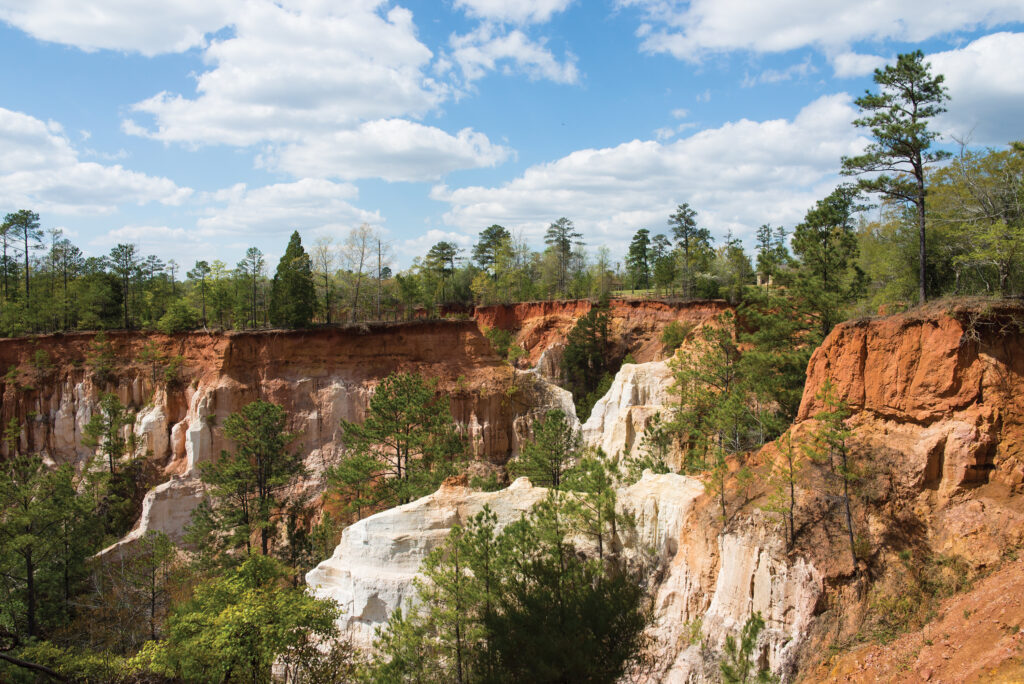
The 1,100-acre Providence Canyon State Park is home to 16 different canyons with gullies as deep as 150 feet. But unlike its Arizona namesake, the gullies at “Georgia’s Little Grand Canyon” were not sculpted by a river over millions of years, but rather rainwater runoff from farm fields in a significantly shorter amount of time.
Once the land of the Creek Nation, the area became a hotbed of cotton plantations in the early 19th century. U European-influenced farming practices of the time eventually depleted and destroyed the fertile ground, leaving behind poor quality soil that could not withstand natural erosion.
Identified by the Department of Natural Resources as one of the Seven Natural Wonders of Georgia, there are 16 different canyons exposing 43 shades of soil ranging from white to shades of orange, pink, purple, and red, as well as the browns and blacks of mineral-stained sediment. Millions of years of geological record are on display in its Western-esque chasms, cliffs, and plateaus.
Providence Canyon State Park has ten miles of hiking trails that all conveniently begin and end at the visitor’s center. Rated easy to moderate, the Canyon Loop Trail is a five-mile hike that encompasses nine of the canyons (canyons four and five are considered the most spectacular!), including hitting the canyon floor. Don’t skip the outer rim of the canyon for a spectacularly scenic view from the top!
Ocmulgee Mounds National Historical Park | Macon
Why this is in our top five: It’s Georgia’s first (and only!) national park.
Remember being impressed by a 200-year-old house still standing in Boston? How do you feel about a place that has had continuous human habitation for the last, oh, 17,000 years?
Prior to its designation as our country’s 64th National Park and Preserve, Ocmulgee was home to four prehistoric cultures – and that’s just before the arrival of European settlers. The earthwork mounds for which Ocmulgee is known were constructed by Native Americans during 900 CE. Representing highly skilled engineering techniques, soil knowledge, and labor organization, these mounds served as ceremonial grounds, burial grounds, and defensive trenches. Visitors can check out culturally historic sites such as the seven mound locations as well as historical museums, all co-managed by the Muscogee Nation, making Ocmulgee the first national park to be operated by a tribe that was once removed from the land.
Located on the Ocmulgee River, the 3,336-acre park features eight miles of trails over 35 miles of protected river corridor. Scientists estimate this corridor is home to 32 mammal, 170 bird, 26 amphibian, 31 fish, and 35 reptile species. Along with traces of over ten millennia of indigenous culture, Ocmulgee Mounds truly tells the story of our country and an ecosystem found nowhere else in the world.
Stephen C. Foster State Park | Fargo
Why this is in our top five: It’s the only place in Georgia that is a certified Dark Sky Park by the International Dark Sky Association.
A trip to the Okefenokee Swamp should absolutely have a spot on your bucket list. The largest National Wildlife Refuges in the eastern United States and one of the largest in the country, the 438,000-acre swamp is one of the most unique places in the world. Stephen C. Foster State Park is the primary entrance to the largest blackwater wetland in North America and one of Georgia’s seven natural wonders.
As you might imagine, the views in a swamp are best enjoyed by boat. Visitors can rent kayaks and canoes or board boat tours at the visitors center. Okefenokee’s most famous resident, the American alligator, boasts numbers in the 12,000s. There are 63 other species of reptile present, as well as 233 bird, 49 mammal, 39 fish, 37 amphibian, and 621 plant species.
Over half of those 420+ animals are nocturnal, making dark the optimal viewing time. In 2016, the park removed all unnecessary artificial light to minimalize the impact on wildlife, as well as other steps that earned Stephen C. Foster the International Dark Sky Park designation. Paired with the natural isolation of the swamp, you’ll enjoy the darkest skies (and best star-viewing) in the Southeast.
Though it’s called a “darkwater swamp,” the water is actually perfectly clear! Thousands of years of decaying plant life on the bottom prevent light from reflecting back to the surface.
Tallulah Gorge State Park | Tallulah Falls
Why this is in our top five: If any 80-foot suspension bridge swaying in the breeze over a rocky bottom of certain death doesn’t thrill you, then we can’t be friends.
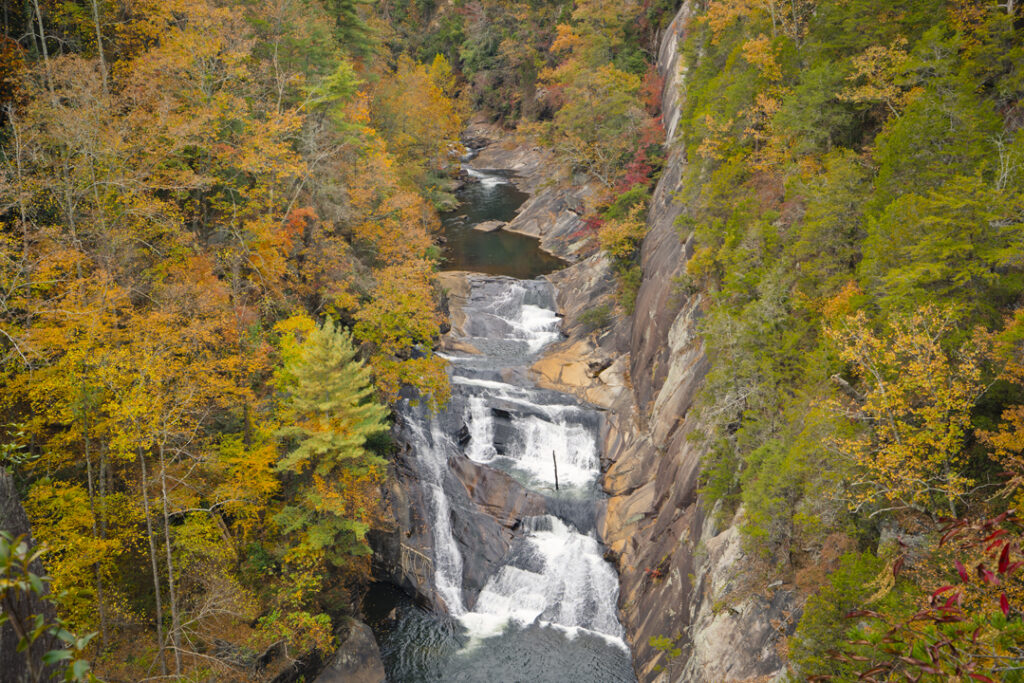
At nearly 1,000 feet deep and two miles long, Tallulah Gorge is considered one of the most spectacular canyons in the eastern United States. Due to the depth, visitors can choose to see the park in one of two ways: up or down.
Believe it or not, if you’re looking for the easier path, go up! The rim trails are perfect for those hiking with kids and pets. You can also view the high-wire towers. I’m sorry, the what? Yep, the high-wire towers: in 1970, aerialist Karl Wallenda walked (and did a handstand) on a high-wire across the gorge. I’ll give you a minute to wrap your mind around that one.
If you choose to go down, prepare yourself for the steps. So. Many. Steps. You also need to be prepared with a pass, because only 100 people per day are permitted to hike down into the gorge. Permits are free and worth the hike to experience Bridal Veil Falls up close and personal. [Pets are not allowed in the gorge, and the hike is not recommended for children under eight.] Those who make it to the bottom can cool off at Sliding Rock, a natural waterslide that empties into a swimming hole. Enjoy the sweet relief, cause now you’ve got to hike all the way back out of the gorge.
But the coolest feature of Tallulah Gorge is without a doubt the aforementioned swaying suspension bridge. The bridge is accessed by the Hurricane Falls Trail and involves over 300 steps – but they’re worth it for the incredible views afforded from the bridge.
Cloudland Canyon | Rising Fawn
Why this is in our top five: A hike that’s two miles long, but 1,000 feet deep.
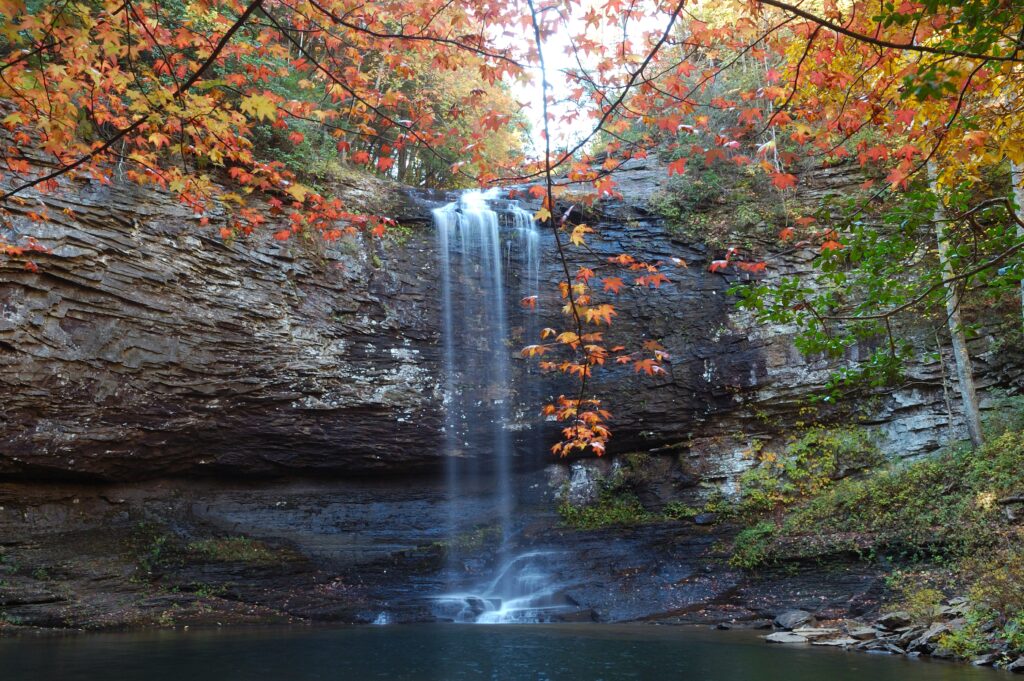
Located on the western edge of Lookout Mountain, Cloudland Canyon is one of the largest and most scenic parks in the state. Sitton’s Gulch Creek has spent the last million years or so cutting a deep gorge into Lookout, creating an elevation range of 800 to 1,980 feet and views like you wouldn’t believe. (Fun fact: Clouldland Canyon actually used to be named Sitton’s Gulch before it became a state park.)
With 60 miles of hiking, 30 miles of biking, and 16 miles of horseback trails, there’s a path for most every method of park transportation. Into the scenery but not the hike? A fantastic view can be found near the picnic area parking lot. But since you’re reading this, I’ll assume you’re in for the hike. Which is good, cause this one’s a doozy – but we’ll get to that.
The most popular trail at Cloudland, the West Rim, was named one of the top ten hikes in the United States by Backpacker magazine. This five-mile, moderately strenuous hike features overlooks, boulders, bridges and streams, and other cool scenic breaks, making it perfect for families. And if you’re up for the aforementioned challenge, follow the signs to the waterfalls and start heading down.
While only two miles long, the Waterfalls Trail comes in at a hardy 1,200 steps – twice as many as the number to get to the suspension bridge at Tallulah Gorge. The trail hugs the side of the gorge and rewards those who put in the time of the stair machine at the gym with twin waterfalls cascading over layers of sandstone and shale. The park also includes an 18-hole disc golf course, caves available for exploring during select months of the year, geocaching, and fishing.
The fishing pond at the end of an easy hike down Meadowlands Trail is stocked with catfish. Best of all, you can borrow a rod from the Interpretive Center on weekends and no license is required. You can even keep what you catch from Labor Day through December!